

Some cities you give a week; Prayagraj we gave six hours. We were bound for Ayodhya, but this old city of confluences — Prayag from its very inception, named Allahabad only later under the Mughals, and revered through every name as Tirtharaj, the king of all pilgrimage places — pulled us in on the way. We rolled in around one o'clock and did not leave until the lamps came on. Nowhere near enough, of course; but even a skim across the surface of a place this deep leaves its mark. This is an honest account of what we managed to see in those hours: the sacred Sangam mid-transformation, a park where a young revolutionary made his last stand, the museum that tells his whole story, a plate of chaat we won't soon forget, and — as the light went gold — a goddess who vanished. If you, too, find yourself with only an afternoon here, this is how to spend it well.
Making a short stop count
Half a day buys you a taste, not the whole table. We had to let the Allahabad Fort and Anand Bhavan go — they're on the list for a longer return. What we did see links up kindly: the Sangam sits a short auto-rickshaw ride from the rest, and the park and museum share the same green grounds. Autos are the simplest way to move between stops, and — as you'll see — a good auto driver is worth more than any guidebook. Go in the cooler hours if you can; we were out under a flat midday sun, and the heat is real.
Triveni Sangam
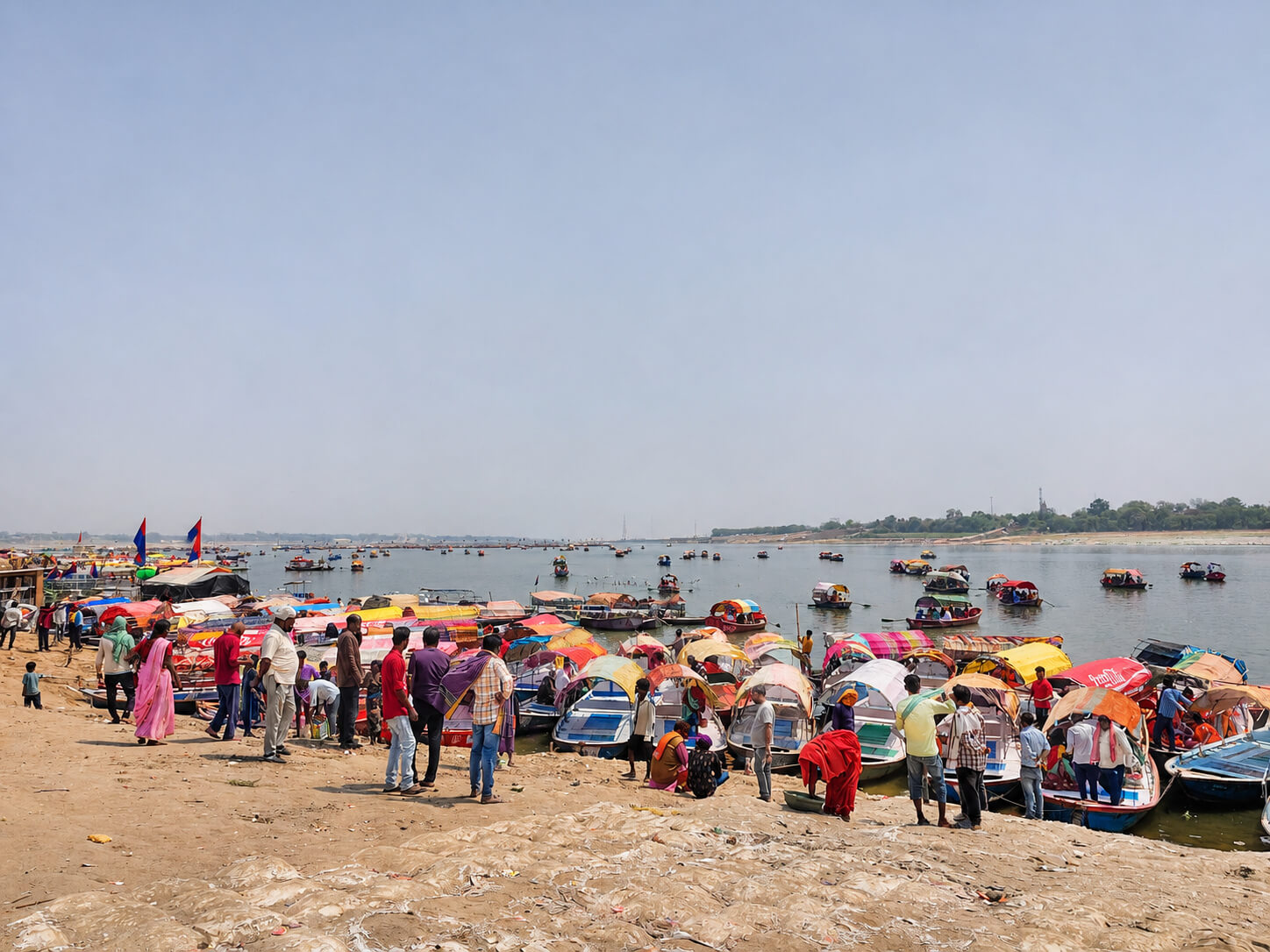
This is the heart of it — the Triveni Sangam, where three rivers meet: the Ganga, the Yamuna, and the unseen, mythical Saraswati, believed to join them from below. For pilgrims, a dip here is said to wash lifetimes clean, and on an ordinary day you would hire a boat from the ghat and be rowed out to the exact confluence, where the two visible rivers run side by side in different colours and priests perform their rites.
We came at an extraordinary moment, and I'll be honest about what that meant. The great Maha Kumbh was still months away, but its preparation was everywhere: the far banks being levelled, pontoon bridges laid across the water, the bones of a vast tent-city rising from the sand, flags strung to the horizon. So we met the Sangam in its in-between state — not the serene confluence, not yet the roaring gathering of millions, but a sacred place quietly holding its breath before the largest human assembly on earth. There was a strange wonder in that, watching a whole temporary city willed into being on a riverbed. Doesn't it move you, to catch a holy place mid-transformation?
Good to know
- Entry to the Sangam area is free; the boat ride is the cost. On normal days a shared ride runs roughly ₹200–300, private boats more — but prices swing wildly, so fix the fare (and whether it's per person or per boat) before you step in.
- Early morning is best — softer light, calmer water, thinner crowds.
- During Kumbh and its build-up, access and routes change constantly; ask locally and keep your plans loose.
Chandra Shekhar Azad Park
From the river we went to the shade. Laid out in 1870 and once called Alfred Park, this is the city's largest and greenest — a colonial-era expanse of old trees and long paths, with a great flowering mango tree at its heart and schoolchildren scattered across the lawns. But its name now belongs to someone else entirely. It was here, on 27 February 1931, that the revolutionary Chandra Shekhar Azad — cornered by British police — fought to the very end and, with his last bullet, chose to fall on his own terms rather than be taken alive. He was just twenty-four.
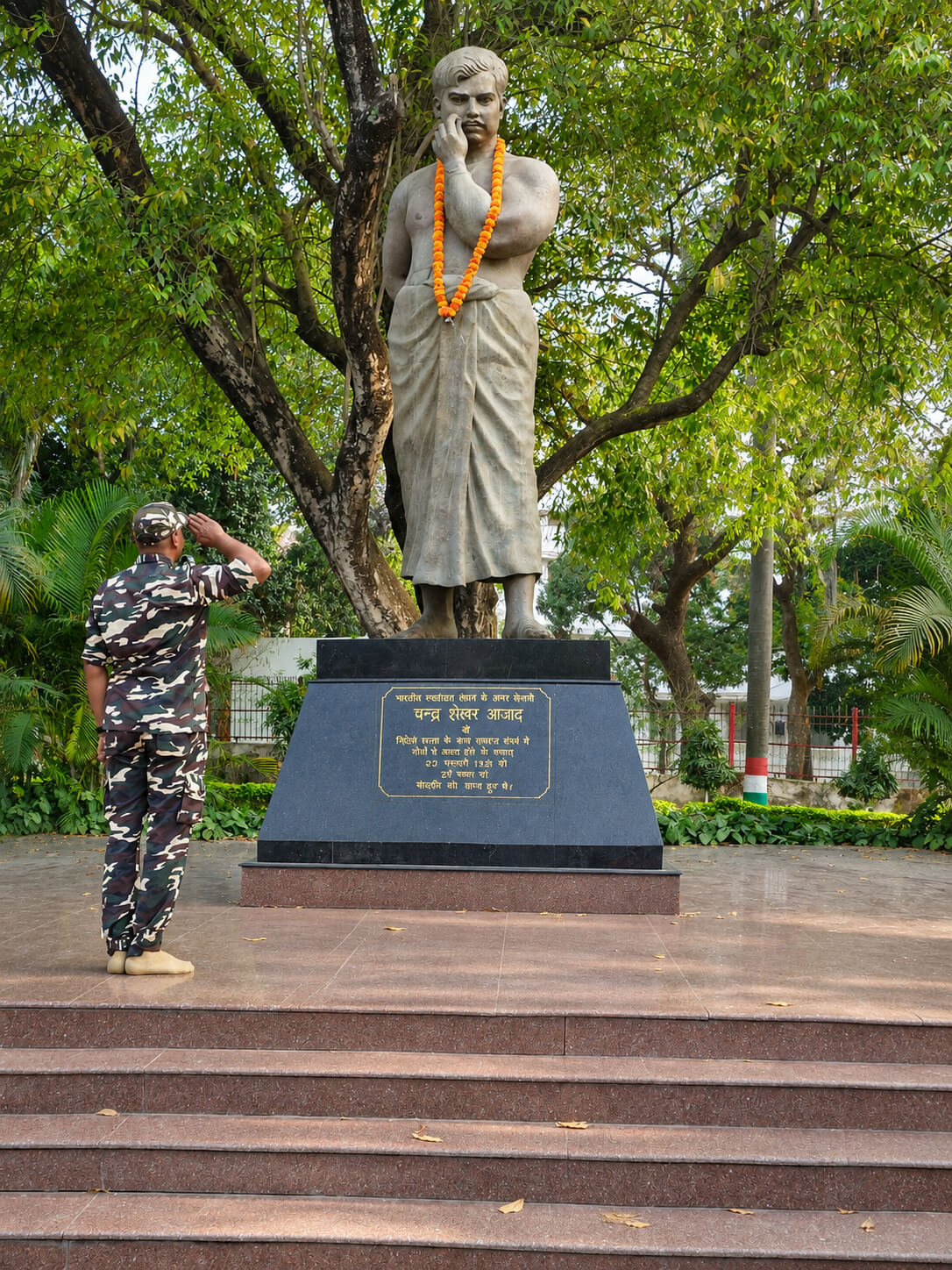
Standing before his statue, garlanded in marigold, you feel that weight settle. While we were there, a paramilitary soldier walked quietly up the steps, stopped, and saluted him — a small, unasked-for act of remembrance that said more than any plaque. The pedestal records it plainly: born 23 July 1906, martyred on this very spot. The park also holds the public library and, tucked within it, the museum. Come for the history; stay for the shade.
Good to know
- Free to wander; a small token charge may apply at the gate.
- Pleasant through the day, but mornings and late afternoons are kindest in the heat.
Allahabad Museum
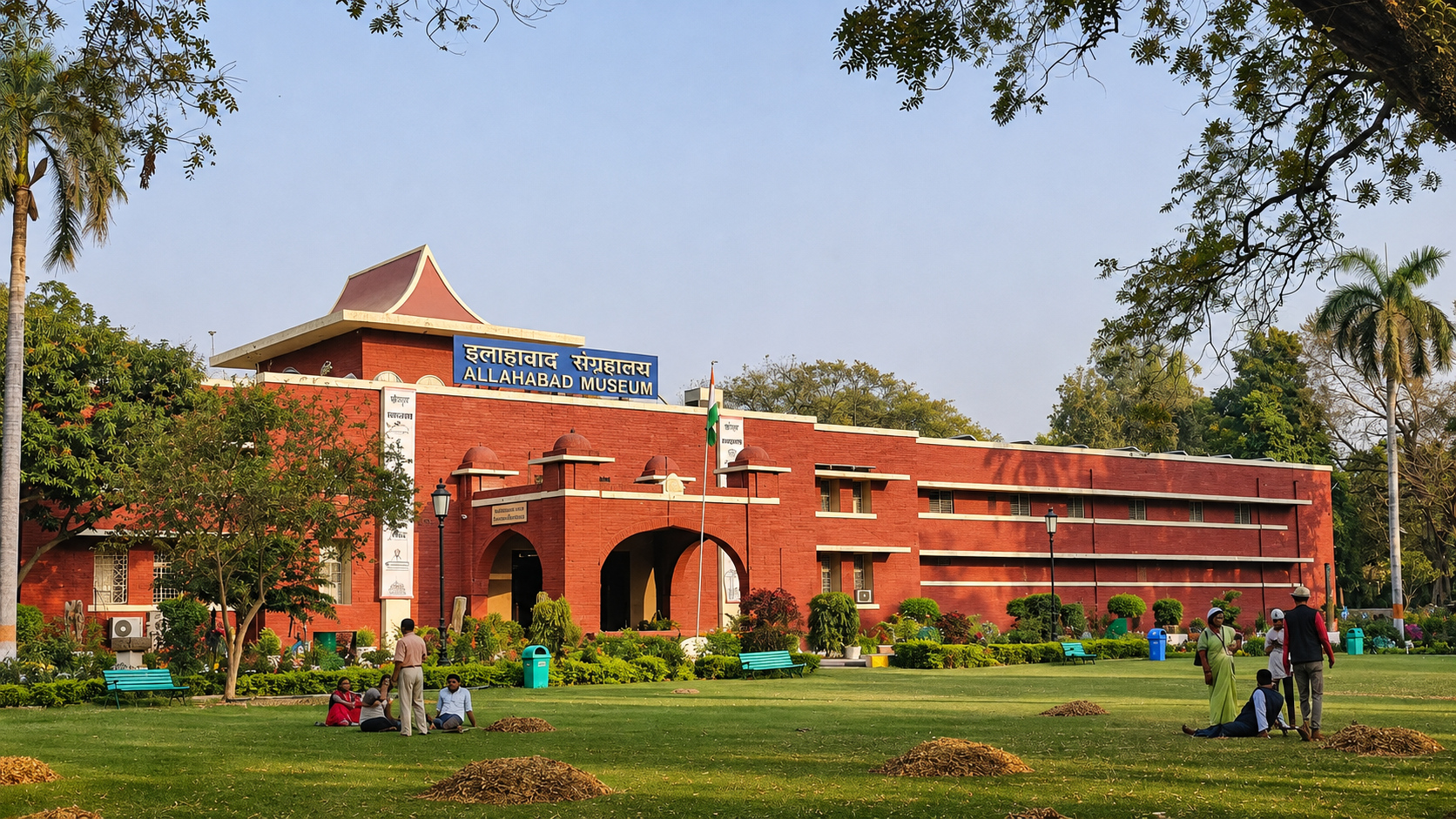
Within the same park stands the Allahabad Museum, a handsome red-brick building that has gathered India's past since 1931. Its quiet triumph is a beautifully designed wing on the freedom struggle, and especially the revolutionaries — and it lands all the harder because you've just come from Azad's park next door.
The whole arc is here: the Partition of Bengal lighting the fuse; the bonfires of Swadeshi; the rise of the revolutionaries from Aurobindo Ghosh to Bankim Chandra's Vande Mataram; Khudiram Bose; the Kakori train action with its full-size steam engine; the Central Assembly bombing; a sobering Jallianwala Bagh diorama; a full wall for the women who fought; right through to the 1947 front pages. At its centre is Azad himself — from Chandrashekhar Tiwari, the boy flogged at fourteen who took the name Azad, to a replica of the .32 Colt pistol he fondly called "Bamtul Bukhara." To stand before that pistol, having just stood where he fell, is to feel the whole day quietly close its circle.
Then the museum exhales into gentler, older rooms: a breathtaking sandalwood chariot of the Gita — Krishna counselling Arjuna — gifted to Jawaharlal Nehru in 1956; a long Rajasthani scroll painting; a gallery of old arms. A fine, unhurried place to end the day's sightseeing.
Good to know
- A small entry fee (around ₹20–50 for Indian visitors), plus a nominal park charge.
- Closed on Mondays — plan around it. Open roughly 10:30 a.m. to 4:30 p.m. otherwise.
- Expect to pay a little extra to carry a camera inside; give it about an hour.
Auto Driver's Favorite Chaat - Pandit ji Ki Chaat
By now the afternoon was softening, and here is a truth of travel: the best food tips rarely come from guidebooks. Ours came from our auto-rickshaw driver, who would not hear of us leaving Prayagraj without stopping for chaat — the city's great, beloved street food. He was entirely right.

What arrived was a small leaf-bowl of pure Allahabadi joy: a crisp base drowned in cool white dahi and dark, sweet-sour tamarind chutney, crowned with crunchy sev, a scatter of fresh coriander, and a dusting of spice that caught at the back of the throat. Hot, cold, sweet, sharp, crisp and soft, all in one messy, wonderful mouthful. We ate it standing on the pavement, as chaat is meant to be eaten. When your driver's finger points to a chaat stall — follow it. He knows.
A few tips
- Chaat is everywhere in Prayagraj; look for the busy stalls with a steady local crowd — turnover means freshness.
- It's generous and filling; one plate shared between two is a fine way to taste without spoiling your appetite.
Alop Shankari Shaktipeeth
And then, as the sky turned gold, our last stop — and quietly my favourite. In the Alopibagh quarter, not far from the Sangam, stands the Alopi Devi temple, also known as Alop Shankari, one of the revered Shakti Peethas. Pass beneath its red gateway — flanked by two golden lions and inscribed in both Hindi and Tamil, a small sign of how far its pilgrims travel — leave your shoes at the step, and enter.
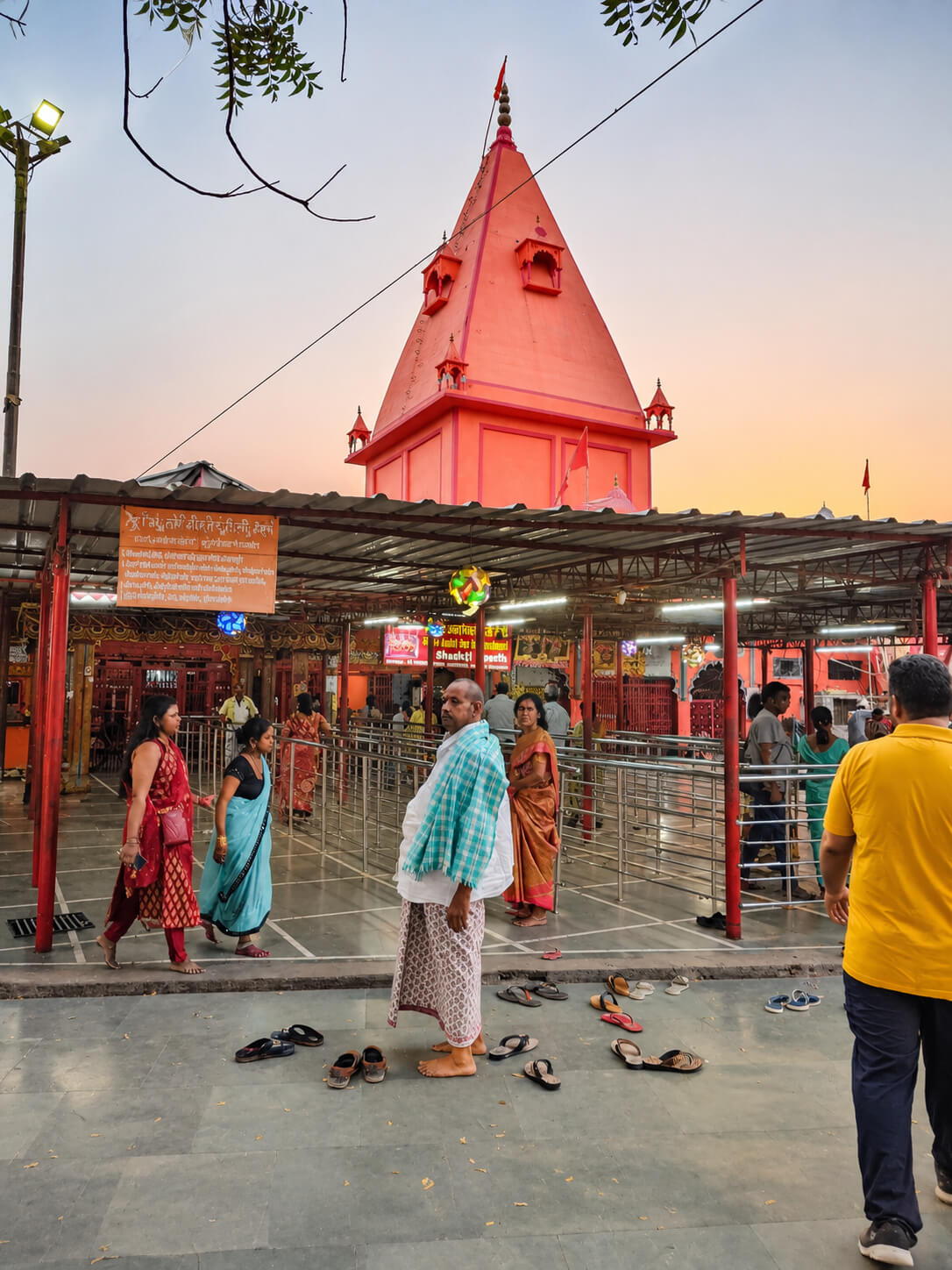
What makes this shrine unlike any other is what you will not find: there is no idol. "Alop" means vanished, and tradition holds that a part of the goddess Sati's body fell here and simply disappeared. In its place, devotees worship a wooden cradle — a doli wrapped in red cloth — and many tie a sacred thread, a raksha sutra, in hope of the Mother's protection. There is something deeply moving in a faith that venerates not a form but an absence, a presence felt rather than seen. We arrived at dusk, among the quiet press of evening worshippers, and it was the gentlest possible note to end our day on. Isn't it strange and lovely, to close a day of rivers and revolutionaries before a goddess who cannot be seen at all?
Good to know
- Open through the day, roughly 6 a.m. to 10 p.m.; no entry fee. Darshan is quick on an ordinary evening.
- Dress modestly, leave footwear at the entrance, and go gently — this is a living, busy shrine.
- Navratri is its great festival, when a large fair fills the grounds.
A few practical tips
- These five make a natural half-day loop: the Sangam first (ideally early), then the park and museum together, the chaat and Alopi Devi as the light softens.
- Don't come on a Monday if the museum matters to you.
- Hire an auto for the afternoon and let the driver guide you — ours shaped the best parts of our day.
- Carry water, a hat, and patience for the midday sun.
- With more time, add the Allahabad Fort and Anand Bhavan — we couldn't, and they're our reason to return.
Leaving Prayagraj
As we drove out toward Ayodhya in the last of the light, it struck me that confluence is really the whole idea of this place — not three rivers only, but histories and faiths all running together: the sacred and the colonial, the ancient and the revolutionary, a martyr's sacrifice and a goddess's vanishing, a soldier's salute and a shared plate of chaat, all in one dusty, luminous afternoon. We only brushed its surface. But some cities give you enough, even in a few hours, to know you will come back.