

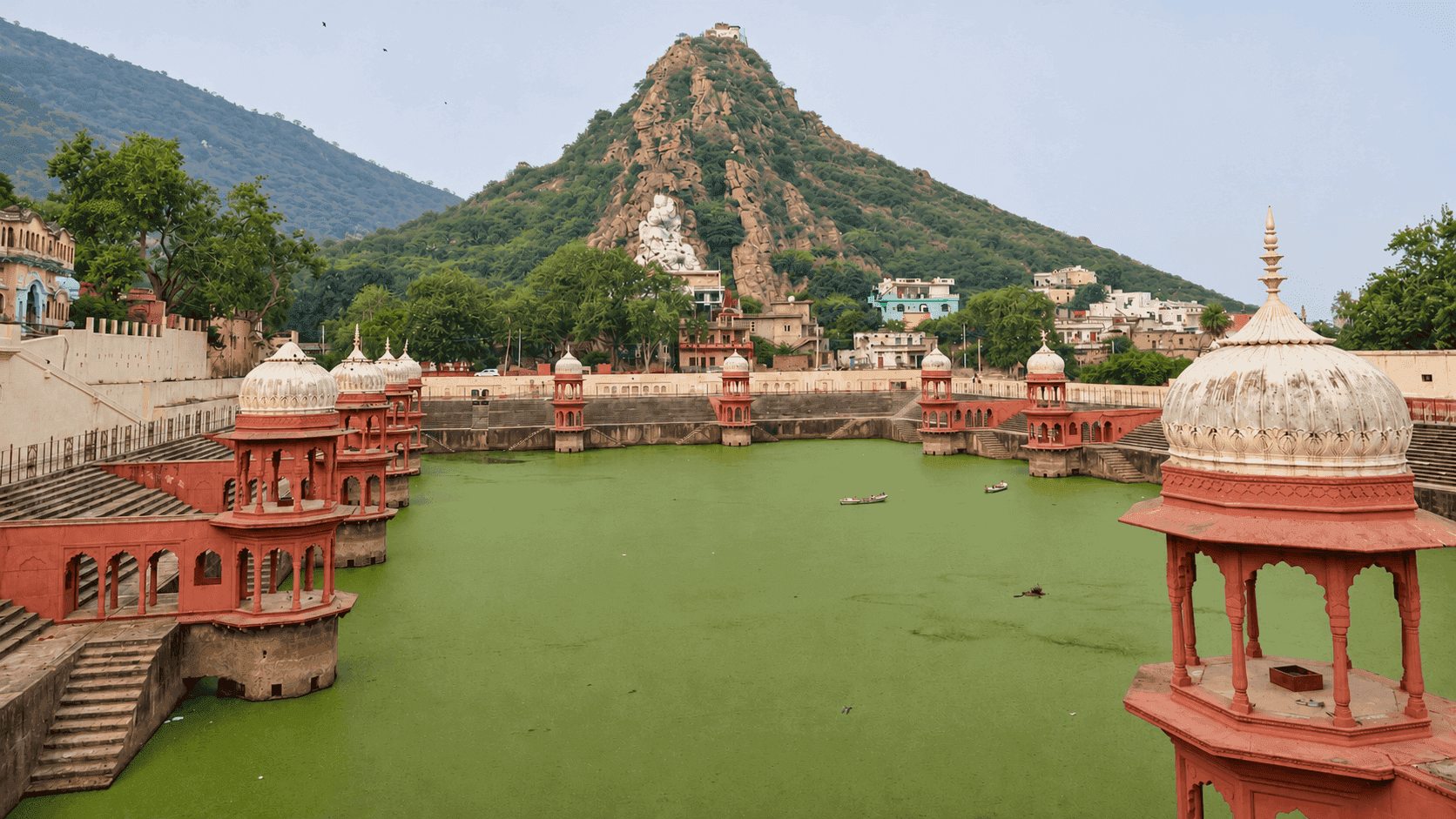
Alwar’s hills are never far from view. They rise behind the palace, frame the domed pavilions at Sagar and follow you out towards Siliserh and Sariska. In my photograph of Sagar, the water is olive green, the chhatris are weathered red and white, and a rocky hill fills the background. It is a good introduction to a city whose architecture and landscape belong in the same frame.
Set among the Aravallis in northeastern Rajasthan, Alwar sits between the wider Delhi and Jaipur regions. Often called the Scotland of Rajasthan, it has a landscape of ridges, valleys and lakes that can look especially green after rain. The comparison is an affectionate nickname; Alwar’s dry hills, sandstone buildings and busy bazaars have a character of their own.
The city is also an easy place to underestimate. Sariska attracts much of the attention, but the old centre deserves time before you head into the forest. Start with the palace and museum, walk around Sagar, then follow the streets back towards the markets. Beyond town, leave an afternoon for Siliserh and a separate day for the countryside.
This journey brings those places together, with a suggested three-day itinerary near the end. The photographs come from different visits rather than one continuous three-day trip.
A Little History Before We Begin
Alwar’s position near Delhi made it strategically valuable, and its fort changed hands long before the princely state took shape. In 1775, Rao Pratap Singh captured Alwar Fort and founded the state of Alwar. Later rulers developed the palaces, gardens and royal collections that form much of the city’s heritage today. [1]
The hills provided defence; the city below became the centre of court life and administration. That relationship is still easy to see around the palace, where the fortifications occupy the heights and the buildings gather beneath them. It helps to keep that wider setting in mind as you explore.
Old Alwar: From City Palace to Sagar
City Palace and the Museum Upstairs
City Palace stands in the old city, at the foot of the hills, beside the Sagar–Moosi Maharani heritage cluster. Its courtyards make a natural starting point before moving towards the water.
The palace’s construction began under Maharaja Bakhtawar Singh, with substantial work continuing during Maharaja Vinay Singh’s reign. The museum information board photographed during my visit explains this gradual development. It is a useful reminder that the palace grew through successive rulers rather than appearing all at once. [2]
Rajput and Mughal influences meet in its arches, balconies and marble pavilions. In the courtyard, look closely at the pavilions and their lotus-shaped bases. The surrounding buildings also retain an everyday purpose: parts of the complex house government offices, so a visit takes place alongside the working life of the city. Follow the public visitor route rather than treating every doorway as part of the museum. [3][4]
Upstairs, the Government Museum gives the palace a more personal scale. The information board records that it formally opened to the public on 12 June 1940, drawing on collections assembled and preserved by Alwar’s royal family. Selected royal objects had already been exhibited in the palace in 1909. [2]
The collection ranges from sculpture and inscriptions to manuscripts, paintings and arms. Persian, Sanskrit, Urdu and Hindi manuscripts sit within a broader story of the court’s interest in literature and art. The armoury brings a different side of royal life into view, with swords, shields and firearms. Giving the museum time makes the palace more than an attractive building: it becomes a place where objects explain something of the people who occupied it.
Plan this part of the day around the museum’s current opening hours. The courtyards, museum and neighbouring monuments are close together, but they deserve more than a quick circuit.
Sagar: Steps, Chhatris and the Hills Beyond
From the palace, continue to Sagar, the stepped tank immediately beside the palace and Moosi Maharani ki Chhatri. This is where the setting opens up. Broad flights of steps descend towards the water, while domed pavilions project from the banks.
Their repetition gives the tank its shape. Close by, a canopy fills the foreground; farther away, the smaller pavilions lead the eye along the opposite bank and towards the hillside. The palace, neighbouring buildings and hills remain part of the view, giving Sagar a sense of enclosure without making it feel cut off from the city.
The water in my photograph is covered in green algae. It is a detail worth leaving in the story because it is part of the place as I photographed it. The appeal lies in the arrangement of steps, stonework and hills, even when the water offers no clear reflection.
Walk a little along the accessible edges before settling on a viewpoint. The relationship between the canopies changes as you move, and looking back towards the palace gives a different impression from looking out towards the hill. [5]
Moosi Maharani ki Chhatri
Beside Sagar, Moosi Maharani ki Chhatri is the royal cenotaph adjoining the City Palace complex. Maharaja Vinay Singh commissioned it in 1815 in memory of Maharaja Bakhtawar Singh and Moosi Maharani. [6]
Its materials make an immediate impression: red sandstone supports a lighter marble upper storey, with columns, arches and domed pavilions above. Move closer and the broad outline gives way to carved details. Look overhead too, where the ceilings carry painted and sculpted scenes associated with mythology and court life. [5]
The view from the upper level brings Sagar back into the visit. From here, the stepped banks and pavilions can be read together, with the surrounding hills behind them. The palace, tank and cenotaph are best explored as one connected setting; each gives the next a little more meaning.
Bala Quila: The Fort Above Alwar
Bala Quila, or Alwar Fort, occupies the steep ridge above the old city. From below, its walls follow the uneven terrain; from the heights, the city spreads out between the hills.
The history panel I photographed inside the fort traces its beginnings to a hilltop stronghold associated with Alaghu Rai in 1049 CE. It describes later additions under the Nikumbhas and Khanzadas, followed by Mughal and Bharatpur connections. These layers help explain why it is more useful to think of Bala Quila as a fort developed over centuries than as the work of a single ruler. [7]
The panel also records that Babur stayed here after the Battle of Khanwa in 1527, and that Pratap Singh took possession in 1775. Its account continues into the nineteenth century, when Bakhtawar Singh added structures within the complex. Gateways, water reservoirs, residential spaces and temples made the enclosure a place to live as well as defend. [7]
My photographs from the fort visit in November 2023 include a wide view over Alwar. Haze softens the buildings and the more distant ridges, but the scale of the setting remains clear. Seen from above, the city’s closeness to the hills becomes much easier to understand.
Bala Quila access note — checked 4 November 2026: Alwar Tourism currently lists the fort as temporarily closed to tourists, without a reopening date. The photographs here are from an earlier visit. Confirm access with the Alwar Tourist Reception Centre before planning an ascent. [8]
Back Among the Markets at Hope Circus
Return towards the centre and the mood changes around Hope Circus, the circular landmark within Alwar’s old market area. Shops and surrounding bazaars bring you back into the daily rhythm of the city.
Inaugurated in 1940, the landmark has stairways approaching from four directions. The area also has an older connection with the walled city: Alwar Tourism places the former Lal Darwaza and its dome in this part of the market. [1][9]
Leave some time here for lunch or tea rather than moving directly between monuments. Nearby market streets include Bazaza Bazaar and Saraf Bazaar. Alwar’s milk cake is another reason to pause, whether you buy a piece to eat there or take some away for later.
This is a convenient end to the old-city circuit. The palace and Sagar give you the formal heritage setting; the markets show the city continuing around it.
Beyond the Old Centre
Purjan Vihar: A Garden Break
Purjan Vihar, also known as Company Garden, is a separate city stop beyond the palace–Sagar cluster. It fits well between the old centre and an afternoon outing.
The garden was laid out in 1868 during Maharaja Sheodan Singh’s reign. Maharaja Mangal Singh added the summer-house feature known locally as Shimla in 1885, and Maharaja Jai Singh later changed the garden’s name to Purjan Vihar. [10]
Shade and planted paths offer a welcome change after the stone courtyards and market streets. It is worth allowing yourself an unhurried stop here, especially if the afternoon is warm. The summer house also adds a small piece of royal history to what might otherwise seem simply a pleasant city garden.
Moti Dungri and the Palace That Disappeared
Moti Dungri is a rocky hill within Alwar’s urban area, separate from the Bala Quila ridge. Its name can lead to confusion with Jaipur’s Moti Dungri, so check the city when looking up directions.
One of the most interesting details in my museum photographs concerns the building that once stood here: Lansdowne Palace. The caption beneath its old photograph dates the palace to 1882 and describes it as a royal residence with 102 rooms. It remained the principal residence of Alwar’s maharajas until 1928. [11]
According to that display, Maharaja Jai Singh had the palace dismantled with the intention of building a larger replacement, but the new palace never materialised. The caption also notes that marble columns and ornamental pillars from it were taken to the Circuit House compound. This account differs from the shorter tourism website description, so the detail here follows the photographed museum display. [11]
Knowing that history changes the way you look at the hill. The surviving setting has to be imagined alongside a building that is now most clearly encountered in an old photograph. It is a worthwhile connection to make after visiting the museum.
Bhura Siddh: A Local Temple Stop
Bhura Siddh belongs to the Alwar city portion of the journey, rather than the excursion into Sariska. The name appears in Rajasthan’s Devasthan Department temple listings. Online maps distinguish similarly named old and new Hanuman temple entries around the Alwar–Jaipur Road and Aravali Vihar area, so confirm the intended temple locally before setting off. [12][13]
It brings another aspect of Alwar into the route: a place of local worship alongside the royal monuments. Keep the visit simple, follow the temple’s customs and allow worshippers their space. A reliable foundation date was not established from the material available for this article, so it is better to leave its age unstated than attach an uncertain history to it.
Siliserh Lake: An Afternoon Outside the City
Siliserh lies outside Alwar, approached from the Jaipur Road side, where the city gives way to a lake enclosed by hills. It is a natural place to slow the itinerary down.
The palace beside the water was built by Maharaja Vinay Singh in 1845 for Queen Shila, as a royal retreat and hunting lodge. The building later became a hotel, keeping the lake view at the centre of its appeal. [14]
After the close arrangement of buildings around Sagar, Siliserh feels more open. The shoreline curves away, the hills sit farther back and the water gives the eye room to travel. A terrace view helps you take in the wider setting, while time closer to the shore offers a different sense of its scale.
Late afternoon is a good part of the day to leave free here. Watch the changing light on the hills, have something to drink and let the stop last longer than the time needed for a photograph. Boating may be available, subject to local conditions and operation on the day. [14]
The view will vary with the season, water level and weather. A quiet, hazy afternoon can still be rewarding; the lake does not need a dramatic sunset to justify the journey.
Towards Sariska: River, Forest and Pilgrimage
Natni Ka Bara and the Ruparel River
Natni Ka Bara, also written Natni Ka Baran, lies at the edge of the Sariska landscape beside the Ruparel River. It works as a pause on a suitable road route between Alwar and the reserve.
The hills draw close around the river here. Alwar Tourism links the name to local folklore about a woman skilled in rope-walking who performed between the hills. It is a story attached to the landscape, rather than a documented event that can be dated with confidence. A temple dedicated to Devnarayan Ji stands across the bridge. [15]
Water and season make a considerable difference to the view. Come for the river-and-hill setting as it is on the day, and leave enough flexibility to stop if conditions are appealing. If you have an early safari booking, keep this for the return journey rather than risking your reporting time.
Sariska: Give the Forest Its Own Day
Sariska Tiger Reserve lies southwest of Alwar within the Aravalli hills. The former royal hunting landscape now draws visitors for wildlife and the experience of travelling through its forest. [16]
Its dry deciduous woodland, rocky slopes and valleys offer a different landscape from the city. Tigers are an obvious attraction, but sambar, chital, nilgai, langurs and birds also belong in the experience. The forest is worth watching between sightings, when the changing vegetation and terrain become more noticeable. [17]
A safari needs its own place in the itinerary. The drive to the correct gate, reporting and the excursion itself take time, so avoid surrounding it with a long list of other stops. Book through the official forest system and check the gate, reporting time and identification requirements on your booking.
This part of the journey also asks for patience. A sighting can be brief or may not happen at all. The pleasure of being in the reserve has to leave room for both possibilities.
Pandupol Hanuman Ji
Pandupol Hanuman Ji is reached through the Sariska Tiger Reserve gate, making access part of the planning rather than a detail to settle after arrival. [18]
The temple is associated with traditions about the Pandavas’ exile, and the surrounding rocky passage is known as Pandupol, or the Pandu gate. These associations belong to the site’s religious tradition. They give the outing a different purpose from a wildlife safari, even though both take you into the broader forest setting. [18]
Confirm the permitted temple-entry days and transport arrangements before leaving Alwar. A safari reservation should not be assumed to include a temple visit. If the two outings cannot be combined comfortably, give Pandupol a separate day.
Planning Your Visit: Three Days, with Room for a Fourth
Allow three full sightseeing days for this Alwar route, excluding Bhangarh. That gives the old city a proper day, leaves an afternoon for Siliserh and reserves time for one Sariska safari. A fourth day helps when Pandupol needs a separate outing or you want more time for photography.
The plan below is a suggested itinerary, rather than the chronology of my visits.
Day | Suggested route | How to use the day |
|---|---|---|
1 | City Palace and Government Museum → Sagar → Moosi Maharani ki Chhatri → Hope Circus and markets | Begin with the museum’s opening hours, then keep the neighbouring heritage sights together. |
2 | Purjan Vihar → Moti Dungri → Bhura Siddh → Siliserh Lake | Arrange local transport and leave the later afternoon free for the lake. Confirm the intended Bhura Siddh temple. |
3 | Sariska safari → Natni Ka Bara when it fits the road route | Make the safari booking the fixed point. Add Pandupol only if its separate entry and transport arrangements permit it. |
Optional 4 | Pandupol or a return to a favourite location | Useful for temple access, photography or a more relaxed pace. |
Bala Quila is excluded while its temporary closure remains in effect. If access resumes, allow additional time and adjust the city itinerary rather than squeezing it into an already full day.
Walking works within the palace–Sagar–chhatri cluster and around the markets. A car or taxi makes the outlying stops much easier to connect. Arrival and departure travel are additional: three days here means three usable sightseeing days.
Continuing to Bhangarh
Bhangarh brings a different setting into the journey, with ruined streets, temples and the stories that have gathered around them. Give it a separate outing and enough daylight for the visit and return travel.
The journey there is part of the companion article:
Alwar to Bhangarh by Shared Cab — The Journey Before the Ghost Stories
Bhangarh is additional to the three- or four-day itinerary above.
Leaving Alwar
The picture I return to is Sagar: weathered domes beside green water, with the hill rising behind the city. The museum adds names and dates to that view, while an old photograph of Lansdowne Palace suggests how much of Alwar has changed.
Farther out, Siliserh and Sariska make room for a different kind of visit, one shaped by light, landscape and whatever the day brings. Give Alwar a few days and there is time to appreciate both—the detail of a painted ceiling and the long view towards the hills.