
We reached Vrindavan in the dark, on no sleep, and let a town built for a cowherd god put us back together.
We left Ayodhya in the evening and drove through the night, and somewhere in those small, cold hours — the kind where the highway dhabas fall quiet and your own thoughts get loud — we rolled into Vrindavan. No grand arrival. Just a dusty car, four heavy eyelids, and a town already stirring for its god. We didn't check in, didn't rest, didn't think twice. We went straight to Bankey Bihari.
Looking back, that was the right instinct. Vrindavan isn't a place you ease into. It's the forest where Krishna is said to have spent his boyhood — stealing butter, teasing the gopis, playing the flute you half-expect, even now, to hear drifting down a lane. The town carries all of that lightly, on every wall and in every doorway. And it gives more to the traveller who turns up tired and open than to the one who turns up rested and ticking off a list.
Getting Your Bearings
Vrindavan sits in the Braj region of Uttar Pradesh, a small temple town a short drive north of Mathura and an easy turn off the Delhi–Agra road. It is dense, walkable, and devout to its bones — less a sightseeing grid than a living shrine you wander into.
- Where it is: About 15 km from Mathura, 55 km from Agra, 150 km from Delhi. Most people arrive by road, or by train to Mathura Junction and on from there.
- Best time: October to March, when the heat loosens its grip. The weeks before Holi are electric — and heaving. Peak summer is punishing; skip it if you can.
- How long: One full, unhurried day covers the two temples most people come for, Bankey Bihari and Prem Mandir. Give it more if you want to go deeper.
- Getting around: Walk, or take an e-rickshaw between the big sites. The old lanes are too narrow and too alive for a car — leave it parked.
- Where to base: Stay in Vrindavan itself. We did, and it turned Mathura, Govardhan and Barsana into easy day-trips out and back.
One honest piece of planning, learned the hard way. Bankey Bihari and Prem Mandir are both right here in Vrindavan, ten minutes apart. We saw one on our first morning and the other on a different evening entirely — which meant driving back into town on a day we'd already left it. Don't be us. Do both temples in a single day from your Vrindavan base: Bankey Bihari in the morning when the deity is fresh, Prem Mandir in the evening when the marble catches fire. The town hands you a perfect arc. All you have to do is not break it.
Bankey Bihari Mandir
You don't so much visit Bankey Bihari as get carried to it. The temple hides at the end of a knot of bazaar lanes — flower sellers, peda shops, the warm press of a thousand other pilgrims — and then, suddenly, you're inside, the crowd becomes a current, and all of it is pointed at one small, dark, impossibly tender image of Krishna as Bihari ji, the one who delights.
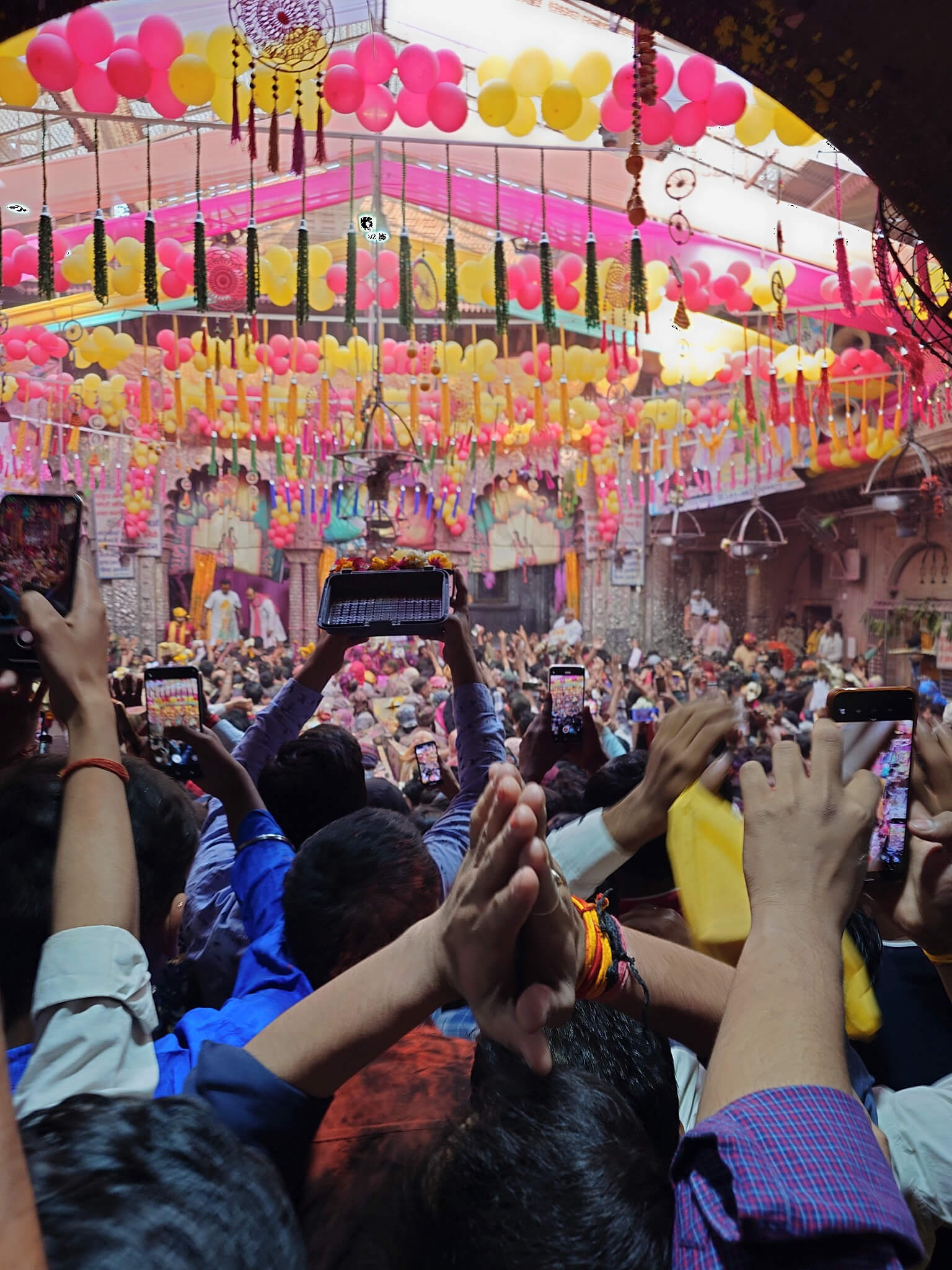
And then there is the curtain, which makes this darshan unlike any other in the country. Every minute or two, a priest draws a cloth across the deity and opens it again. The belief behind it is gentle and a little heartbreaking: Bihari ji's gaze is so full of love that, met too long, he might rise and follow his devotee home — so no one, deity or devotee, is ever allowed to hold the look long enough to be lost in it. No bells ring here. No conch sounds. Nothing is permitted to startle a god who is still, in his heart, a playing child.
I'll be honest — it is overwhelming, and not always in the serene way the brochures promise. The crush is real. You will be shoulder to shoulder, moved more by the crowd than by your own feet. But there is a strange grace in giving in to it, in being one body among thousands all leaning toward the same small curtain, all waiting for it to part. Hold onto that feeling. It is the whole point.
Good to know
- Entry: Free. Ignore anyone outside offering paid "VIP" or "special" darshan — the temple runs no such line.
- Timings: Two sessions with a long midday break, and they shift with the season — roughly a morning slot (from around 7:45 AM in summer, a little later in winter) until noon, and an evening slot (from about 4:30 to 5:30 PM) until 8:30 to 9:30 PM. Confirm the current hours before you set out.
- Your phone: Keep it pocketed. The lanes are tight, the crowd tighter, and pickpockets work both. You'll see more with your eyes than through a screen anyway.
- Mangla aarti: The dawn aarti is held here just once a year, on Janmashtami — a rare darshan if your dates ever align.
- Dress and timing: Modest, traditional clothing. Go early on an ordinary day, and give Holi and Janmashtami a wide berth unless the crowd itself is the experience you're after.
Prem Mandir
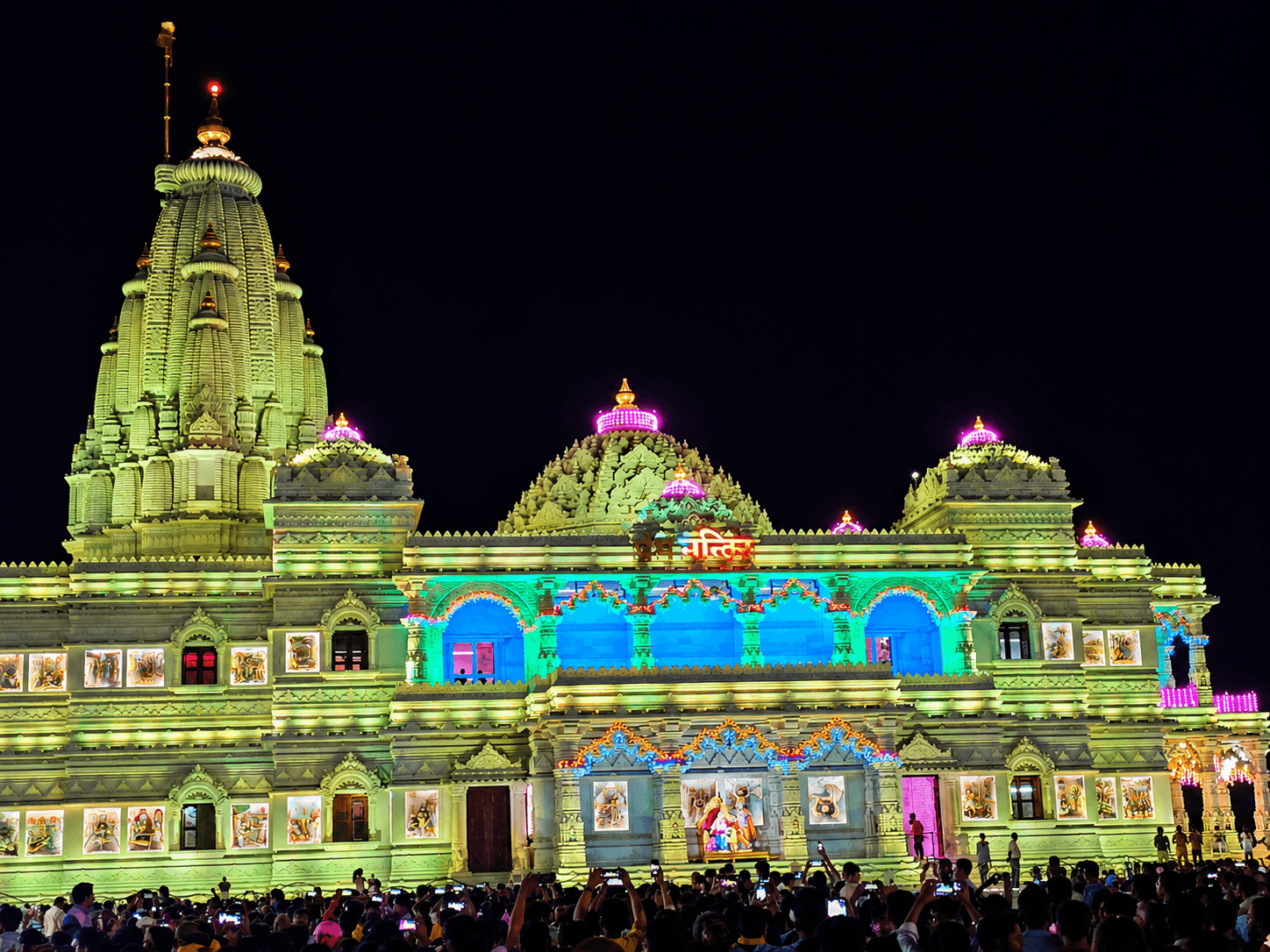
If Bankey Bihari is the old heart of Vrindavan, Prem Mandir is its newest breath — and the two could not feel more different. Where the first is close, dark and thronged, this one is open, white and vast. Raised in gleaming carved marble and finished only a little over a decade ago by Jagadguru Kripalu Ji Maharaj, the Temple of Love does not whisper. It sings.
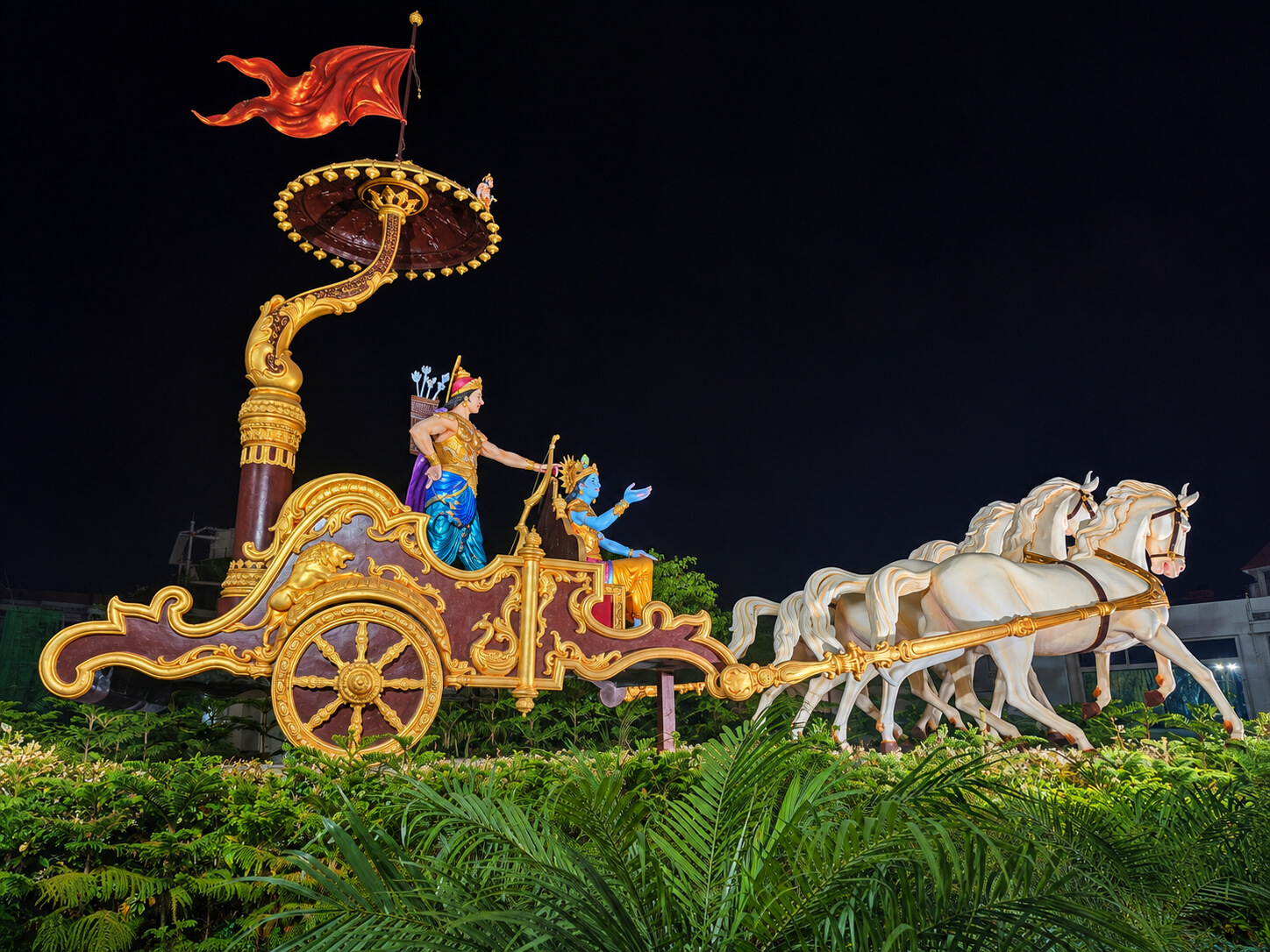
Come in the evening. That isn't a suggestion — it's the point of the place. As the light goes, the whole temple begins to change colour, washing slowly from rose to gold to deep blue, until the marble seems less built than lit from within. Out in the gardens, life-size tableaux tell Krishna's stories in stone and paint — him lifting Govardhan hill on a single finger, dancing on the hood of the serpent Kaliya, ringed by gopis in the raas. Children chase each other between them. Families spread out on the grass. It is devotion, yes — but devotion at ease.
After the morning's crush, I'll admit, it felt like being let out to breathe. We sat on the warm marble as the fountain show began and the temple turned through its colours, and no one was in a hurry, and for a while that was more than enough.
Good to know
- Entry: Free, like nearly everything in Vrindavan.
- Timings: Morning roughly 8:30 AM to noon, evening roughly 4:30 to 8:30 PM. The evening is when it comes alive.
- The light and fountain show: Usually around 7:00 to 7:30 PM in winter and 7:30 to 8:00 PM in summer, running twenty to thirty minutes. Arrive by 6:30 to claim a good spot.
- Time needed: Two to three hours, easily. Don't rush it.
- Dress: Modest — no shorts or sleeveless tops — and shoes come off at the racks outside.
What We Left for Next Time
Two temples is not Vrindavan. It is a doorway into Vrindavan. I'll be honest about what we didn't reach — half confession, half map for you.
- Nidhivan — the hushed, tangled grove where, the faithful say, Krishna and the gopis dance the raas each night, and no one dares stay to watch.
- ISKCON Vrindavan, the Krishna-Balaram Mandir — bright, musical and welcoming, with kirtan that can lift you clean off your feet.
- Radha Raman and Radha Vallabh — two of the town's most loved older temples, quieter than Bankey Bihari and all the richer for it.
- Seva Kunj — another grove wrapped in that same tender legend of the nightly dance.
None of these fit into our single day, and we didn't force them in. Vrindavan is not a checklist to clear; it's a town to come back to. We will.
A Few Practical Tips
- Go barefoot-ready. You'll be slipping shoes on and off all day. Easy footwear and a small bag to carry them saves a lot of fuss.
- Carry small cash — for the shoe stands, the e-rickshaws, and the box of Mathura peda you will absolutely end up buying.
- Guard your belongings in the Bankey Bihari lanes: phone deep in a front pocket, bag held in front of you.
- Dress modestly at every temple. It's expected, and it's a small courtesy that quietly opens doors.
- Do the two temples as one day — Bankey Bihari in the morning, Prem Mandir in the evening — and spare yourself the backtrack we didn't.
- Come hungry. Braj runs on pede, kachori-sabzi, and thick cold lassi, and you'll want room for all of it.
Final Thoughts
We came into Vrindavan in the dark, running on nothing, and we left it full — of colour, of noise, of that odd, buoyant lightness the town seems to hand out for free. One day held both the crush and the calm: a curtain drawn again and again over a god too loving to look at for long, and a marble temple glowing through every colour of the evening sky. Vrindavan carries those two moods in the same small hands, and quietly asks you to carry them too.
Give it a day. Give it your tiredness and your attention both. And when you're done, don't pack up for home just yet — Mathura is minutes away, Krishna's birthplace is waiting, and somewhere just ahead the whole of Braj is about to drown itself in colour. The flute, as ever, is still playing. We followed it on.